reabc/Prison Writings of Anarchist Rob Los Ricos - Rob Los Ricos/Prison Writings of Anarchist Rob Los Ricos - Rob Los Ricos.pdf
Web PDF • Imposed PDF• Raw TXT (OCR)


![‘The most hideous aspect of this death culture is that the powerful have convinced the weak to desire their obliteration. The powerful get the weak to destroy themselves and do it as a sacramental duty. Some of the weak can see the destruction they are visiing upon their world. They do what they can fo limit the destruction. They fail fo realize that the lesser of two evils is stll evil. These “kinder-gentler” destroyers are so afraid of looking at the consequences that they fight whole-hearedly fo defend the rights of the powerful to desiroy our world and denounce any efforts to oppose the machinations of the death-culture. But not everyone is blind to the workings of the killers of the Earth. Not only that, but there are sfll millions of people ‘who are not connected fo the apparatus of the death-culture. These two types of people nol only try to minimize their impact on the living planet, but they fight to stop the death machines. The powerful and the weak alike hate the primifivists. The powerful must destroy them in order o maintain their privileged status. The weak must destroy them so that they don’t have fo face their own cowardice. Also, they - being weak - are totally dependent on the death-culture - without it they would suffer and perish immediately, rather than slowly. The powerful and the weak make war on the uncoopera- tive, the wild and the free. They are as effective as they are hearfless. The powerful use fear o force the weak to kill the rebellious and the free. The weak are mofivated by fear - fear of offending their masters, fear of losing their [illusionary] status, fear of being killed themselves. If ear is the only mofivation the weak understand, per- haps it fime for the uncooperative to make the weak fear that which they have embraced. L Perhaps its time for »\l:’l:mve and ‘n?rogn e powerful awake in their bunkers. Perhaps it s fi offensive and make the powerful and weakédlike pay forheir crimes against nature. Perhaps it’s time for a two-sided war.](Prison Writings of Anarchist Rob Los Ricos - Rob Los Ricos 37.png)




![then from one another]. That means devoing our life energy fo making these changes, as opposed fo working for wages or otherwise acquiring money. This may sound scary and weird, but let me clue you in on something: Many native peoples have Jestivals where everyone gathers together and gives away all their possessions. At first, some people may have a lot more than others, but by the end of the festival, everyone pretty much has an equal share. Such outpourings of communal devofion are such a threat fo civilized alienation that they are illegal in Canada and the U.S. Ponder over that for a moment. It is evident then that not only must a new social order arisg outside of the current one but it must be done in secretfThe govetament will not allow it. Itis up o us, ourselves, our friends d we love, to create a future we can truly believe in, ofje thatpro? duces healers instead of serial killers, that cherishes teachers, not athlefic rapists. That means sacrificing a lot of privileges. It means facing fimes of peril, material deprivation, even hunger. But what is the allenative? Nearly universal poverty, famine and infernal wars of attrition like the war on “drugs” and “ter- rorism.” Creating new lives for ourselves won’t be easy, but the rewards are unimaginable. Giving birth is always ths way.](Prison Writings of Anarchist Rob Los Ricos - Rob Los Ricos 44.png)


prison writings of anarchist
0B T B
Manufacturing Dissent
audio visual terrorism
www.audiovisualterrorism.com
table of
discentents
Forewarned
Interdiction
Manufacturing Dissent
Stateless People vs. the State
DLLY. Anarchy
Chaos
Leaders?.... We Don't Need No Stinking Leaders
Direct Action
legalism
What Are You Doing, Officer?
Rob Los Ricos vs. Chumbawumba
Let ‘er Rip
You Have a Right fo Riot
Biocide
Culture Clash
Expolitation = Expoitation
Delirious Insurrection!
Anarchy in Black and White
Towards a Fugitive Future
An Inner-view
ferewarned
The self described “one hit wonder anarchist rock star”
Rob “Los Ricos” Thaxton wasn't always a rebellious “rock star”,
or an anarcho-activist, or a punk political prisoner. There was a
time, not that long ago, when he was just another chavo
chicano growing up in some forgotten field fown called Pampa,
Texas, Walching rebels, reformists, riofers, racketeers, and real
rock stars tap dance across his tv screen. But while changing
channels, culture, capitalism, corporatization, and the clarion
call of chaos came crashing down in the form of the
radicalizing revelations of the terroristic Tet Offensive; the
political proclamation “No Vietnamese ever called me i
of black (power) boxing champ Muhammad Ali; and finally, the
seditious inspiration of the women fighters of the radical
Weather underground who seized his catholic grade school for
two years when he was a child. By the righteous (rlage of
twelve, Rob began to work with various revolutionary organiza-
tions, and eventually left Pampa for the streets of Dallas, Texas,
where he joined CISPES (the Committee in solidarity with the
People of El Salvador), worked with ACT UP, and KNON-FM, a
peoples (Pirate) radio slation, where he served as prograf
director.
In the early 90s, as Rob Thaxton began to fade ifig,aye
‘memory, and Rob Los Ricos entered the forefront of a
radicalized reality, he began fo delve deeper into the history of
the international anarchist movement, and once again relo-
cated, this fime fo Ausfin, Texas, to engage in anarcho-specific
activity. He began fo focus his polifical energy info
(dis)organizing with the small anarchist movement that existed
in Austin, and also worked with The Palestine Solidarity Com-
mittee, Earth Firstl, The Black Banner Brigade, and organized
street protests against the gulf war and deiqred actions against
globalization.
But the mute mainstream media silence over any opposi-
fion to the war, and the perceived ineffectiveness of the protest
that he had been organizing and atiending, led Rob fo believe
that “protest-as-usual” was a wasfe of fime. He then made it his
mission fo develop anarchist networks throughout Texas, and
traveled within the entrails of the monster organizing and
revolutionizing. Through the 90s he lived in Portland, Oregon
where he worked with the Anarchist Info Shop, and spent fime
in Columbia, Missouri, where he helped fo publish Anarchy: A
Journal of Desire Armed, and Allernative Press Review, as well
s working on book projects of the Columbia Allernaiyelibrary
Press.
By the late 90s, Rob began to reexamine his anare
ideas in order to redirect his efforts fo create a life igi&é
his desire for a liberated existence. He also became a father (fo
his daughter Raven) and abandoned urban existence to “redis-
cover a simpler way of life” that included low impact gardening
techniques, eco-Friendly architecture, and low-tech living in the
woods of southern Oregon
On June 16, 1999, Rob Los Ricos traveled o Eugene,
Oregon fo attend an anarchist conference and a Reclaim the
Strees fesfival. Arrested by police during the June 18 Reclaim
the Streets demonstration-turned-police riot, Rob was accused of
throwing a rock at a cop, and was subsequently beaten by
police. He was ulfimately charged with riofing, fist degree
assault, and second degree assault. Used as a Lafino, out of
fowner, anarchist scapegoat example of what can happen o
those who dare fo rebel, Rob was given a nearly 8 year prison
senfence.
Determined to continue la lucha even while in the belly
of the beast, Rob and his supporters in Portland, Oregon
formed the Anarchist Prisoners’ Legal Aid Network, a resource-
sharing and communication network for incarcerated anar-
chists, and Rob continues fo struggle and to dream and o write.
Hopefully, this “punk pamphlet will give you @ bit of incite into
the ideas and idedls of the Chicano, working class, anarchist,
political prisoner known as Rob Los Ricos.
- Not4Prophet
interdictien
Rob Thaxton loves beer. And the woods. And people,
especially his daughter. Rob hates thi ilization” we are
crushed by ever He hates hypocrisy, greed, white su-
premacist racist imperialism. And he hates to struggle. Which
makes him a normal human being. Its the fact that Rob has
spent the last three years in a prison cell, and will spend five
more there, because of his commitment fo create a world some
would consider a utopian dream, that makes him amazing.
1 first met Rob as a picture on a fiyer. “Free Rob Los
Ricos!” | was living in Portland, Oregon at the fime, and had
heardiabout the 1999 police riot in Eugene, Oregon that had
resdliéd in one person being charged with assault. This was
clB§&%5,the “The Battle for Seattle.” “Authority” was unprepared
for thefresistance that took place, the property damage, the
defiance in the streets. The government blamed the “black
hooded anarchists” they imagined were behind these actions,
and especially focused on Eugene, which the media decided
was a hotbed of anti-authoritarian, anti-amerikan acivity.
On June 18, Rob was the one they caught in their net,
and because he was from out of town, because he was an
activist/writer/organizer, and most definitely because he was
brown, he was singled out and given an outrageous senfence
for throwing a rock at a cop. The cop came out of it with a
bruised chest. Rob was bealen severely enough to break bones,
and got almost 8 years in prison.
1 started wriling Rob in solidarity, because | felt he had
golten royally fucked over, and because | realized that with the
work | was doing, that could very easily be me, as the loud-
mouthed spot of color at many a protest.
| was also very intrigued by Rob. A Chicano brotha,
who's also an anarchist? Now that was a stumper. Living in the
very white northwest, | had known politically active anarchists,
sure, but they were all white. | had never even considered,
before reading Rob's wrifings, that a brown person could be an
anarchist. Even knowing Rob existed began fo change my
polical ideology, and pushed me fo reexamine what | believe.
Rob is an incredible political thinker who is able to link
up 3000 years o history fo show why owning a credit card
makes you a slave. Moreover, he is able fo take the principles of
anarchism and point out how the current incarnation is
eurocentric and white-centered. That leaves space for black and
brown peoples o reclaim anarchism, which s in reality very
simple idea that indigenous folks all over the world have been
practicing before the advent of “civilization”.
He has also pushed me to recognize ways that | make
allowances for this system, out of convenience or comfori. Rob
calls me on shit that | just took for granted, but in actuality ends
up feeding the same Babylon beast | thought | was working fo
tear down. The brotha's got a million ways to unplug, discon-
nect, fall off the radar, get behind enemy lines and become a
big pain in the ass fo the establishment.
With every letter or article he writes or visit | make, he
challenges me too reevaluate and relearn what | thought was a
damn fine political foundation. Even when our debales, infuriate
me, they're always infused with humanity and humor. Rob has a
witty, sardonic edge that cuts through all kinds of civilized polite
bullshit. Rob makes me question everything and has made me
reclize, ullimately, that the only things worth fighting for are he
simple things: laughter, ife, rees, o home-cooked meal, a good
homebrew, children playing, friendship. The rest is
smokescreens designed to confuse the real issues.
Over the three years that | have known Rob, he has
become much more than a political prisoner to me, more than
an inspiration and a mentor. He is those, but most importantly
he is one of the best friends | hwldz reminds me that he and
other political prisoners are an; or symbols; they're real
people, just ke you and me, wh hais siruggle and war, but
love life enough o engage in that sicuggle, hoping that there
ill be a time when he can walkin the woods hand and hand
with his daughter.
- Walidah Imarisha
manufacturing
dissent
| remember reading The Communist Manifesto when |
was 12. Perhaps loo young, since | had an instant knee-jerk
reaction to the phfdse “dictatorship of the prolefariat.” |
wrestled with thatfor a while, since, otherwise, | was thrilled
with the ideas {36 there. | began o study more generalized
socialist writerstanditheir philosophies, though most of them
were pretty boring o me then. | finally came across some
anarchist books and thought, “Ah, now we're gelting some-
‘where! Revolufionary socialism without a dictatorshipl” But, |
was wrong, as some anarcho-syndicalists also proposed a brief,
transitional “dictatorship of the workers.” And, there were the
anarcho-communists. And the anarcho-individualists, and the
anarcho-christians and anarcho-capitalists. There seemed fo be
a different form of anarchism for every occasion. This turned me
away from anarchism for a good, long while. It seemed o me
then that anarchists couldn'l agree on anything. But, after
having to deal with various communists and other oddball
socialists over the course of years of political activism, I finally
embraced anarchism, with all its flaws and schisms because - as
an anarchist - | didn't have to tow a party line or endlessly bleat
any leader’s words. And, as | came into contact with more and
more anarchists, | found that most of us could agree o disagree
on many issues but stllfind enough common ground to support
one another's activities and actions, whether or not we chose to
directly participate in them. The important thing was to keep the
pressure on - to work, educate, agitate for a better life.
In meeting and talking with other anarchists, | came to
realize that some anarchist crifiques of our society were taking
on broader and still more divergent paths toward liberafion, not
only of socely, but from society as well. | was - and'stil am -
thrilled to be part of a movement which discusses and chal-
lenges the very‘roots of civilization fo get to the root of oppres-
sion and permanently eradicate it from our existence. To this
day, more and more rifts in the anarchist movement are making
themselves apparent. Add to the above menfioned tendencies
anarcho-pagans, anarcho-primitivists, anarcho-punks, eco-
anarchists and you have a good listing of most of the major
trends in current anarchist thought. The outsider might look at
this situation and think, “Wow, how fortunate to be part of a
movement with such diverse ways of approaching ifs concerns.”
Sadly, the truth is that for over a century now, there have been
serious splits in the anarchist community - particularly in
America - which prevent us from unifying our efforts and pre-
senting a solid challenge fo the existing order. The syndicalists
accuse the individualists of being elitist, the anarcho-communists.
accuse the primitivists of being unrealistic, the individualists
accuse the syndicalists of fefishizing the working class. If that's
not enough dissension, there is a current war of words raging
between the so-called social-anarchists - the libertarian/
municipalists - and their dreaded gpposition, the mythical
“lfestyle anarchists.” “Mythical” bacayss there is not now, nor
has there ever been, any group or ‘which has called
itself “lfestylist.* Then wha’s the fuss 3l about? No one can say
for sure, but now that there are ess: g and lines being
drawn, there is the possibility that an “unbridgeable chasm?” is
being built - indeed, manufactured - within the anarchist com-
munity. This could signal the birth of a stronger, livelier brand of
21t century anarchism as the last residual adherents of 19th
century anarchist ideology slips into the past, or the squabbling
may continue until anarchists find themselves marginalized and
irrelevant in the siruggle against global capitalism.
stateless peeople
vs. the state:
creating anarchy
in the 21st
century
There have been several books and essays written about
the need for anarchists to move their theories and activities
beyond the current scope of oppositional politcs. Despite the
stated desire to do so, few people have actually made the
attempt. Indeed, there has been an almost decade-long stagna-
tion of anarchist activities. Anarchist gatherings throughout the
90s have rehashed the same subjects (pirate radio, cooperative
housing, food not bombs, efc.) and have succeeded in building
nation-wide networks of people working on these projects.
These all are worthy starting points to create foundations for
further advancement of liberatory struggles. Yet, that next step
has not developed out of them. The amount of fime and effort
required o do even these limited projects so drains the re-
sources and energy of those involved that there is little atiempt
made at moving them forward in a more revolutionary direc-
tion. If anything, their revolutionary potential is played down in
order o prevent reactionary forces from feeling overly threat-
ened by them, or for the sake of gefting along with the neigh-
bors. Some activists have not only given up on any attempts to
create liberatory changes in their lives and how they interact
with the larger society, but have even gone so far as fo encour-
age ofher anarchists fo do the same. Worse stil, they somefimes
vefor o this back-peddling as “revoluion.” If anarch,
next centuy
groups ar ‘activities and address the commond large - all
those who share our level of exploitation and alienation, and
especially those who suffer even gredter levels of oppression.
This hardly requires anarchists fo give up, waler-down or
drastically alter their goals and theories. Rather than retract,
there is @ need o expand anarchist visions and activities, to find
people who are exploring similar methods of thought and -
action and learn and grow along with them, hopefully in‘a'spi
of mutual solidarity. It is in this expansiveness that anarchists wil
find the directon for growth which has been lacking for foo long
in North American acivism.
Anarchy really has no form or shape - ifs basically a
do-it-yourself ethic that should empower people to take respon-
sibility for their owry lives, witheut relying on coercive forces fo
provide for them. Ictualfj{&fefor to use the term choos over
anarchy, because ¢haos mathematics includes the
precept that everything affacfsiverything else — that everything
is conneced fo mrfi&m else in some way or another. | also
like the idea that chaos also implies that siluations cannot be
controlled, certainly not by pififully puny human beings. In
hundred thousand years, our species may be exdinct, but ife will
go on. Perhaps what evolves out of the mess our beautiful
homeworld is currently experiencing will be something more
incredulously fantastic that we can imagine now.
For now, though, Id like fo see anarchist groups forming
that are devoted fo creating a new social order now! | don't
think there is anything fo be gained by devoting one’s life to the
conlinuation of the corporate-dominated society. In other words,
people whose priorities in life are based on economic concerns
need to admit they are weak and dependent upon the New
World Order and butt out of social change movements. What
needs to happen is that people quit their jobs, give up economic
relationships and learn to re-integrate their lives into the natural
world. And agitate for the right fo do so. Right now, this means
‘we in the consumerist world must halt corporate infrusion into
lands where people still live simply. We also must support the
rights of indigeneous people fo live according to their own
cultural ties 1o the lands where their ancestors lived.
To me, this is the crux of revolutionary struggle - to re-
establish our species into the natural order (chaos, really) of the
earth. Our relationship o the land has always been central fo
revolutions in the past. Anarchists in Spain and Russia fought fo
redistribute land so that people could provide for their family's
needs. “Land and Liberty” was the Zapatistas’ slogan during the
Mexican revolution. In contrast, traditional class war anarchist
movements agitated for control of industry. This is not life-
affirming, nor life-enhancing. As far as 'm concerned, people
who push for “class war” are white supremacists, since they
‘want fo force ever fo live like Euro-Americans. In that
ffetent than the enforcers of the New
‘World Order. 5
i
chaes
Chaos unbound by definitions and forms, doesn't hold
individuals captive in idealogical cages. Free o inferact as
circumstances allow, the chaolic individual’s relation to society is
much like a stingray lying in wait, buried in the sand, a covert
beserker, a warrior constantly on the attack against societal
constraints, imposed roles and morals, who chooses when fo
strike, when to blend into the background and move on fo the
next battle — as benefits a struggle against oppressive forces —
rendezvous with other beserkers to celebrate their liberated
{in’:s and places, to share their plunder, their joy, their love of
ife!
‘
{
+
United S(um
“a strong people need no leader, they are
their own leaders.” - Zapata
A common problem with anarchist zealots and aclivists
in general are their dreams of a perfect society, a utopia. Well,
the world's not perfect and neither are people, so no one should
seek perfection. If's not going to happen. Sci-fi author Ursula K.
LeGuin wrofe an awesome book about an anarchist space
colony, The Dispossessed. The society she describes has all sorts
of peftiness: bureaucracy, regional chauvinism, jealousy, in
short, she envisioned a society that had a lot of pofential for
personal liberty and fulfillment, with all the social ills that are
inherent in human interaction. Too many people use the excuse
that the activist groups they work with will not creale a perfect
society in order o li involvement or commitment fo a
cause or movement. This is dishonest and lazy, not to mention
cowayly. Thesfutyre must be shaped by people bold enough to
act decisively In ler to creale the conditions for a new way of
life f m%‘ > sociely we've inherited clearly isn’t working.
Leadership
e read numerous objections fo anarchy, over the issue
of leadership. Many people feel ke we need strong leaders fo
help us become united and fo help us focus our energy. They
point out that somespeple aprjustnaturally better at organiz-
ing people. This is trugjo a grgdkextent. Some people can
envision projects and see them thrligh fo complefion, whereas
others are confent pitch jnand help out and need direc-
tions. The heart of the matteriis'that leadership should arise and
be utilized organically, and not be entrenched in a bureaueracy
or authority figure. For instance, man may be very good at
designing and having bridges buill, but may know absolutely
nothing about child birth. So why should he be put in a posifion
of aithority that makes his decisions, on everything from con-
struction fo child birth, the absolute rule? Leadership should not
be entrenched iiduals, but should be as much a part of
the community s any other aspect of people’s lives.
What happens fo a group of people who have single
great leader when something happens to that leader? A people
dependant on o great eader would become dishearioner ard
lost, and look fo surrender fo some ofher leader. A people who
share leadership according fo their skill, knowledge and abili-
ties will abways have within their community a group of compe-
tent individuals capable of stepping forward when necessary fo
help the community through whatever difficuly they are experi-
encing. We are all leaders.
direct actien
Direct action means not depending on others — polifi-
cians, the government, the police, corporations - to take care of
things for you, but taking care of issues yourself. For instance,
you and your friends want to drink and need a place fo stay.
So, ya'll roll into Safeway, steal a couple of cases of beer and
then go and fake over an abandoned building. That's direct
action. A great example from recent history comes from Ger-
many, where the 1970s revolutionary group, the Red Army
Fraction, took a stand against their governments plans to build
a super-max prison. The Red Army Fraction didn't write letters
or hold demonstrations fo ask the government to stop construc-
fion. Instead, they blew the (incompleted) prison up and assassi-
nated the architect. This, by the way, happened in the early 90s,
which goes to show that sustained pressure can be confinued
for decades, if the people are dedicated. The idea is: Don't get
o illegalism
“a”Hiighty ffreckless, shameless, con-
scighcelefis, proud, ORIME, does it not
bile infdistant thunder” -lax Stimer,
“Ego and its Own
act in violation of the law. Whether the act is
a conscious defiance of morals and authority, or the realization
of frusirated desires, the criminal rejects the acceptable roles
offered him or her in favor of creating a new self-defined one.
Though this doesn't always lead o a rejection of the dominant
forces of society, rampant and blatant disregard of the law is a
sign of deterioration and usually leads to a complete break-
down of the social order. However when socely is dependent
upon the exploitation and subjugation of ifs citizens, the subver-
sion of the social order by defiant actions and black market
sub-economies and against the forces of law and order offers
people purely symbolic civil disobedience and in no way threat-
ens the stalus quo. Civil disobedience merely reinforces the roles
of rulers and ruled, while black markets need the continued
existence of the state fo limit competition and provide the infra-
siructure which supports both above and underground econom-
ics - mainly currency. Rather than military conflict with the
nation/states or rampant ferroristic campaigns against the
“enemy” population, people who wish to create a revolutionary
situation according to the redlization of an expansive libratory
existence would take into consideration the example of the
illegalists.
French lllegalists
Pre-WWI France was the setting for the only documented
‘anarchist revolufionary movement to embrace all ilegal activity
as revolutionary practice. Pick-pocketing, théft from the work-
place, robbery, confidence scams, deserfion from the grmed
forces, you name it ilegalist activity was praised as a justifiable
and necessary aspect of class struggle. Someofthe most widely
circulated French anarchist newspapers and journals Grged
their readers to commit-crime, including papers published and
edited by Russian expatriale Victor Serge, and Elisee Recluse.
Indeed, it seems that Mr. Recluse’s unrelenting support of illegal
activity has cost him widespread translation and influence in the
non-French speaking nations. One of his biographers referred
o his “flaws in judgment” without discussing his unapologetic
stance on illegalism. Recluse was the only major anarchist
theorist who never recanted his public support of illegalism,
even after the vilfication of The Bonnot Gang and police repres-
sion which followed (see Richard Parry's book The Bonnot Gang
for a defailed account).
In France, and elsewhere since, the suppression of
anarchist working class papers and organization was given a
“tsctsk” by the liberal ulopians, those who wiilo fransforif
society through gradual, peaceful methods (suchias ediation
and establishing cooperatives). This anarcho-at e
tude sfill exists and is one reason why anar an
confinue to be marginalized and all but irrelevant as a revolu-
tionary movement.
Someone might get in TROUBLE
The risk of being caught, hurt and even killed is
in all illegal actions. To the poor and working classes,
a deterrent fo criminal activity, merely part of the equation: “Is
the goal worth the risk?” Afer pondering the pros and cons of
the situation, the criminal gives up or carries on and if caught,
well, that's how it goes, and beter luck next fime.
It is here that class disfinctions enter the picture. To some
poor people, life in jail is not so much worse than life on the
strees. Instead, fo many poor people in the “underdeveloped”
world, life in a U.S. jail would be an almost incalculable im-
provement over the conditions of their current status. When
insurgents take to illegal activity: using underground illegal
squals, carrying out armed robberies to support themselves
efc., among their most vocal crifics are the liberals and act
who, if they were fo be foo closely;assotiated with the llegal
actions of their comrades, could ihnd o lose their student
financing, jobs, or, gasp, trust {gg?s With s6 much depending
on their repulations, the liberals will Sometimes even go so far
as to cooperate with the state in apprehension, denunciafion
and incarceration of those who they feel have gone foo far.
The Uncontrollables
For better or worse, anarchist revolutionary movements
have always attracted people who adamantly refuse to follow
orders or obey rules, even those presented by anarchist organi-
zations. Branded as uncontrollables, these loose cannons bring
discredit fo anarchist ideals or so the high-minded utopians and
scholars would have us believe. However, these same utopians
never fail to have a hand out to accept the plunder shared by
these “bandits and adventurers” in order to finance their publi-
cations, free schools and union activities.
From the period after the repression of the Paris Com-
‘mune through the Spanish Revolution and up to the round-up of
anarchists in Italy this decade, bombers such as Ravachol, gun
men like Ourrufi and bank robbers like those alleged to have
operated in lfaly have inspired loathing by respectable voices of
anarchism while winning admiration and emulation of the
working classes of their countries. The UK's own uprising of
uncontrollables, The Angry Brigade, a group which did not
exist, carried out hundreds of bombings, expropriations, pranks
and stunts. Once the media-generated hysteria surrounding
their fabricated “terrorist” group began, people across the land
joined in. The resuliing turmoil infuriated the scholars and self-
appointed leaders of the anarcho-liberal mainstream, some of
whomhad, i thelr o7, the dubious honor of hovig o send
trial.
That's Revolting!
When social change groups and movements keep fo
their place, as ineffective, impofent, cathartic acivism, their
leaders and spokespersons are awarded accolades and freats.
They become scholars, historians, voices of the alleged repres-
sion. But once they slep beyond the social acceptable realm of
‘whining and gnashing their teeth and truly challenge the au-
thority of their overlords, they are branded as ferrorists and
kooks. This is only appropriate, as the powerful are not in the
least interested in losing their power and privileges. The leaders
and spokespersons of the loyal opposition are often at the
forefront of this effort, lest they lose their social goodies in the
repression of the insurgent uncontrollables. Throughout the
history of anarchist revolutionary movements, those who did the
front line fighting (and suffered the consequences), seldom took
the time to write down their thoughts, acknowledge their inspi-
ration or record their actions. To be sure, such records could
have been used by the state to prosecute their comrades and
loved ones. So, the overwhelming majority of anarchist histories
and other scholarship_has beenwritien by those who pooh-
poohed the daring and Btave insurgents from the
comfort and safety of their stu er, the final acs of
uncontrollable revolutiorfary fuf not yet happened. Unfil
the world, in part or freed from the yoke of
capitalism and all ofher forms of privilege and authority, more
people will revolt and with increasing urgency. Even now, in the
midst of an ever-expanding economy, everyday people are
coming to the realization that western civilization has reached a
dead end and i's time to do something different. More and
more people, especially those under social pressure to find their
vocational niche and get o work, are turning to illegal means to
create an imaginative existence of expansive pofentialities.
They've already weighed the possible consequences of their
actions and have concluded that it is worth.the risk. Because. ..
We have the World to Win and Nothing to Losel
Under the current order, our lives are only nominally our
own. Our governments, our employers, banks and insurance
companies have more say about how we dress, look, think and
what we imbibe then we do. If every facet of our lives is mea-
sured, timed, bought and sold, then can we be said fo be alive,
or have we become animated machinery? To tum from
this horrifying existence is to become an outcast, .Q’Q'Zl off into
marginalization and cross the boundary into illegality.
what are yeu deing,
officer?
Being a police officer is a dehumanizing experience. The
wearing of a badge puts a barrier between the civilian popula-
tion and the law enforcement community. People are wary of
inviting police into their homes, even socially. They ll be polite
and put on a veneer of respect for the po||cu person, but they
‘watch their step around cops. And words. You don't want
to offend someone who is.armed - with guns, clubs and infor-
mation. Information, whm}- in alsg be‘more than weapons.
i
Cops were young le - just *flunyom else - at one
Theylideny
point in their lives. They de ‘that they vandal-
ized neighbors houses/properly. Ther/ll dnny that they ever
drove home drunk from a party, a club or favern or a friend's
house. Ouflaw corporations have desirayed entire bio-regions
despite laws profecting the environ: The fines imposed on
them do not make the slightest dent in their profits, if the corpo-
rations even bother to pay them. When the people whose
homes, land, and heallh were devastated by illegal corporate
activities try to do more than call their congressman (again) fo
stop these activities, here comes the police fo profect the corpo-
rations’ right fo ignore the law. And they do it gladly. If's the
law. In 1930s Germany, it was illegal to harbor or aid (or even
just not tellthe police about) Jews. Many people broke these
laws. Many people shared the fate of their Jewish neighbors
when breaking these laws. I pre-Civil War America, abolition-
ists helped slaves from the South escape to Caniada This was
illegel, too. Some things are more important than laws. Like
neighbors. Like human dignity. Like unspailed land and clean
water.
izations have risen and fallen throughout the course
of human existence. Many civilizations were destroyed by
outside forces - hostile neighbors, natural disasters, famine,
disease, you name it. According to some peoples oral tradi-
tions, though, some people abandoned their civilizations and
voluntarily returned to a simple life of gardening, feasfing,
dancing and raising Babies. Theyigave up their cifies and the
technologies that created thefbéeabse they had the wisdom to
see what their civilizgfion cost e not only environmentally,
but in terms of their'existéfice a3 Tiving, loving creatures and
decided it was foo great a price fo pay.
Are We that Wise?
Here's how you make beer - you put a bunch of yeast
into some water that's been loaded with sugar. Yeast love that!
The yeast flourishes. It eats up all that sugar and reproduces like
crazy. Yeasts are not clever things though. Eventually, there is so
much yeast that they die, choking fo death on their own excre-
ment. Then they ferment and - drink them. Yummy!
Ave “civilized” human beings of the 215t century smarfer
than yeasi? Yeast can't help it. They don’t have brains. But,
more to the point, there is no elite warrior-caste of yeast that
force them to consume and reproduce. Under our present
global capitalist economy, all laws serve to profect corporate
property and their “right” o make profits. All people must
devote their lives to making corporations profitable, to act as
couriers by moving money back and forth between corporations
and banks. Ifs our job. People who do not wish to live fhis way
run afoul of the law. There is no other way to exist in a capitalist
economy. It s the function of the police fo fake these people and
put them info prisons, where they are forced fo work:at gun-
point. Or suffer the consequences. Yet oyr'planet is being killed
by people who only see nature as “resdurces” fo be “devel-
oped.” The genocide committed throughout the Americas was
justified because the land was being “wasted"- not uflized for
monefary gain. Many people of pre-Columbian America didn't
even have a concept of money, much less profit. Enfire regions
based their “economies” on gifl-giving. Everyone alive foday
faces the decision whether they want o be part of a living,
dynamic world, or whether they are yeast, doomed fo drown in
their own waste. That includes everyone who has job fo do.
That includes you, officer. The police forces of every community
have this choice to make: they can continue to follow “the law”
regardless of the consequences of their actions; or they can
abandon their role as a warrior elite in order fo embrace their
ccommunities, and act as facilitators of change, bringing people
together to work out their differences and acting as peace-
makers rather than enforcers.
After World War Two, a war-crimes frial was held. One
of the results of these frials was o establish that citizens of all
nations have a right fo not only dissent against what they con-
sider unethical laws and governments, but fo actively oppose
and resist them. It is in my opinion that the current state of
ecological crisis has reached a point that to continue with every
day business-as-usual existence imposed by the laws of the
capitalist nation-state is to embrace suicide. | am not suicidal. |
love lfe. | love sharing my home with the people | love, working
in the gardens with them in the momnings, drinking down those
dead fermented yeast at night. But | can'tlive according to my
desires. The laws will not all must, therefore, oppose the
laws with every fiber of my being. | owe it to my daughter to
create a space for her o live and grow as part of a living,
thriving world. Its her birthright. | am willing to put my life on
the line to create that space, fo force the capitalist nation-states
fo respect my human right to determine how | will live my life.
There is no room in North America for autonomous village
communities. Yet.... There are, however, armed forces to pre-
vent me and those | love from creating such places. So, how
about it, soldier? How about it, officer? Will you help fucilitate
the chdingesijhat/ére Becessary fo make this world into one we
can all shaté? Or willyou blindly enforce the rule of laws that
forco pacple intgheir roles s yeast?
red les rices
vs. chumbawumba
One hit wonder anarchist “rock star” RobT‘n T}mm:‘
a cop with a rock, regrets hitting cop, will get out
fi:f::?n seven years. One hit wonder rock star anarchists
Chumbewumba had a big hit on the pop charts, regret signing
with @ major label, will have a new CD out soon.
’ .
let er rip
Long before the United States was even a concept,
colonial Americans had been expressing their desires for revo-
lutionary changes in their society through the only means avail-
able o them: rioting. Many people now counted among our
nation's founding fathers argued for years against the violence
employed by the American workers — wage laborers, slaves, ex-
slaves and seamen - fo lterally fight against nis laws and
business praciices. In the end, conservafiyéé e JohAdoms
and Alexander Hamilton threw in their lu)?‘s ‘the violent
masses they had previously denounced as¥a moflsy rabble of
saucy boys, Negroes and mulattos”. Ifs fii%wn the.gonserva-
tives had a change of heart, they merely ucogmefle impos-
sibility of stopping the people’s urges for freedom in their world.
The aristocracy felt a need to try o control and suppress the
peoples” will o fight for liberty, or they ran the risk of being
swept aside by the revolutionary masses. It was not by coinci-
dence that the first action of the United States, Army was fo put
down the insurrectionary forces of the Confiriental-Army.Which
had freed the colonies from British rule. Americans have et fo
lose that fighting spirit, as evidenced by thedatle agéifst the
forces of capital in Seattle during the 1999 Werld Trade Orga-
nization (WTO) conference. While peaceful protesters were
demonstraing once again their ability fo absorb kicks, frun-
cheon blows, pain, compliance holds and pepper spray, hun-
dreds of other people decided to go on the offensive and physi-
cally atiack the insfitutions directly responsibla for the exploit
tion of people in impoverished communities. Horrified by the so-
called violence of the insurgents, the liberals and “professional
activists” rushed fo the defense of McDonald's and Nike. Unlike
the conservative elements of the American revolution, the con-
servative elements of the WTO protests were unable fo stem,
contain or otherwise control the spirited rebels in the streels. So,
in the atermath of the paople’s victory in Seatle, the conserva-
tives have lined up to denounce the jubilant victors. There are
crificisms to be made about the tactical value of riofing to
achieve revolutionary goals. After all, the moment passed, the
damage was repaired and business now confinues as usual, OF
course, this argument can be applied to any protest. In order o
<
affect real change, a movement must sustain the atiack unfil the
social order breaks down completely. Unfortunately, this sort of
willfl non-compliance with the existing order has dire conse-
quences. As Frederick Douglass said, “Power concedes nothing
‘without demand, it never has and it never will.*
Here in the U.S., most people live in a degree of material
comfort very few people in less developed countries experience.
Few Americans are willing 1o jeopardize their comfortable
lifestyles by fighting against the powerful forces that maintain it.
‘When riding upon other people’s backs like they would animals,
the liberal consumer will do anything fo ease the suffering of
those beneath them except get off their backs.
Social and environmental conditions have reached such
a wrelched state that their ridigonsumers are beginning fo
not just question their mlas’?%: rs, but fo reject and
actually fight against thesgfroles. urgent people in the
stroels in Seatlle wmna;g;mg
. They
st Starbucks or Nike or
US Bank or even the W Were expressing their oulrage
that entire families have to work picking coffee beans or they all
go hungry, that young girls are sold into slavery fo work in
Indonesian shoe factories and thal wealthy corporations, banks
and governments want fo find ways to become more profitable,
regardless of the human and environmental consequences.
The street fighters in Seattle tasled a bit of what real
power is like. For a time, they owned the center of a major
American city and they determined that they would not allow
business fo continue as usual. Now that they've fasted their own
power, they'll hunger for more. Will there be more confinuous
pressure against suicidal consumerism until it collapses?
Perhaps as important as the actual fighting will be how
the so-called traditional opposition will react fo it. Wil they, as
they did in Seatfle, jump fo the defense of Nike? Will they climb
down from their positions of privilege, or must they go down
kicking and screaming, desperately clinging to their car keys
and cell phones?
Itis not even ironic that many of these same people who
denounce property destruction in American cities also claim to
support the Zapatistas and other armed insurgents... abroad. If
is not ironic: ifs imperialistic and racist to sit back in a comfy
chair and le! other people provide your cheap food, clothing,
fuel and elecironic gadges for you, while cynically encouraging
them if they rebel agains! their circumstances.
Just as rioting spread through the Americas unfil colo-
nialism was swept aside by the revolufionary urgings of the
‘many, varied people yearning for liberty, the continued uprising
the masses of indigent ex-consumers will one day break the
yeou hn.ve & right
te riet
“¥hen you have to call in additional police
foroes from out of town and send in the NatiGnal
Guard, you're basically saying, ‘anarchish.
Wom.'" ~The Mayor of Washington sumning wp-ihe
aftermath of the anti-WIO riots iniSeatt 3
My first visit to Portland, Oregon and the Pacific North-
‘west revealed fo me a cosmopolitan urban lifestyle that was laid
back, open and a welcomed change from the redneck attitudes
prevalent in Texas, my homeland. Yet undernéath the placid
veneer of the bookstores and coffeehouses, Portland already
had a reputation for being a place hostile to higher authoriy.
During a trip there, then-president George H.W. Bush's mofor-
cade was pelted with broccoli by placard-carrying demonstra-
fors. He remarked, “That felt a little like Beirut back there.”
The reason for my visit to Portland was fo attend an
anarchist gathering there in the summer of 93. After enduring
days of police intimidation of anarchist households, squats and
events, !EZ grand finale of the weekend's events was an all day
punk show at the legendary X-Ray Café on Burnside St., down-
town. The police went way foo far in going after the anarchists.
Seventy cops in riot gear gathered down the sireet — on the
major thoroughfares through downtown Portland - while ofher
cops shut down and diverted traffic. Between sets, the crowd
inside the X-Ray gathered outsides the venue to smoke, chat,
hang out and await the next band.. The show was almost over
when the police ordered the crowd outside fo disperse. Utterly
intimidated, the anarchists, punks and assorted crusties sud-
denly improvised masks and shouled oul their defiance of the
dispersal order, fo the cheering of the crowds. gathering outside
the police barricades. So, the cops atiacksd: Rather than stand
still and be frapped between the advancing police lines, the
crowd surged through downtownina haze oftear gas, with the
police in pursuit. The street battle that followed ended with three
dozen arrests, thousands of dollars of damage fo businesses
and scores of minor injuries fo various police personnel. One
local anarchist activist, Douglas Squirrel (yes, tha’s his real
name) was arrested and charged with conspiracy and inciting a
riot, despite the fact that he had only briefly been to the X-Ray
and left hours before the police showed up en masse.
Want fo fest the legitimacy of a government to continue
its existence? Hold a protest assembly. When the cops come to
disperse you - riofl A truly legitimate government (not that
there’s such a thing) would ot attack a group of is citizens/
subjects gathered fo voice their grievances with their rulers,
People who are generally in agreement with your cause and
those fed up with the government will not only support your
right fo voice your discontent, but may actually foin you'in'the
streets to combat the forces of the rulers. Before there Was such
a thing as voling, rioting was the only way for common’ ‘people
1o effectively challenge the action of - or the existence of ~ fheir
rulers. Oh, sure, there were peaceful means of massing against
the rulers, who were generally very appreciafive of having the
malcontents all gathered in one place as to save the hassle and
expense of a long campaign fo round them up. Instead, the
ruler could massacre them all at once, then grieve the loss of so
many citizens later and make a large donation to the local
church. Then everyone's happy.
Be that as it may, | do not want fo claim that rioting is
always an act of democracy. American history is full of ex-
amples of iofs organized and paid for by various business
communities fo crush people’s movements, particularly aboli-
tionists, unions and other workers' organizations and women
suffragists. As with any strategy or tool, the use of rioting to
achieve one's goals is only as democratic or inclusive as the
participants and organizers.
Genuine revolutionary rioting is seldom actually
planned. Usually, riots are the result of the uuihrxi:(s overreac-
fion to a situation beyond their control. The scary thing to the
rulers isn't the possible damage to the local businesses, jails or
other cenfers of official power. What makes the authorities shit
bricks is that there are people who openly refuse o follow
orders. That's why tyrants insist on assaulting anyone gathered
in opposition of even the most trivial matter. Any system of
government that can only impose its rule by the use of military
force against its own cilizens is a system whose continued
existence is in doubt. As soon as the people see an opportunity,
they Il topple the existing order through society-wide non-
cooperation with the rulers, massive and continued rioting o
outright armed uprisings. i
The day affer the X-Ray Café riot, the city@l ‘
exploded with indignation. Newspay r\%flfi
fo
pers, TV o tol
shows and downtown merchants alllined up o denouncéfhose
responsible for the riot: the Porfland Police Department, Later,
almost all the charges against the punks and anarchists arresfed
were.dropped. The only person left with serious charges was
Douglas Sauirrel (yes, ifs his real, legal, birth name. Really).
‘When his ricl was over, the presiding judge ruled that ~ when
faced with unreasonable hostiity from police forces — citizens of
this couniry have a right o fight back in self-defense. Among
the findings by the court was that the concerl-goers had not
blocked traffic as alleged by police; the police had. Likewise, TV
video news reports showed clearly that several businesses’
‘windows were broken out by police batons. The city was thus
stuck with the bill for repairing damages to downfown mer-
chants.
Revolting Behavior
0 John Z:‘rxan hm’I::ad down |-5 from Pndlundl.in the
college town of Eugene for over 25 years, Few i
gene had heard of John ~ perhaps the most infimal living
anarchist writer ~ before 1999. Finally, the years of local activ-
ism and writing brought fogether @ group of like-minded anar-
chists who were ready fo stand up to the forces of authority: the
corporations, banks and their lapdogs, the government and
their police forces.
‘ed B Wilh over-exploitation of nearby forests, extinc-
tiof6Flecali@imal and plant species, pollution by industry and
the sul orkers, locally and in the third world coun-
triesfBy local'€erporations, the anarchists held a demonstration
in the streets of Eugene. When the police aftacked, the anar-
chists scattered and attacked appropriate targets, including
Niketown.
Only a few months had passed when the worldwide 6/
18/99 Reclaim the Streels festival sprang up in Eugene. The
police came ready o fight. The result Twenty arrests, eight cops
injured and thousands of dollars in damage fo Eugene banks
and businesses. Despite the media hysteria about anarchist
“violence,” as many people clearly sided with the anarchists as
cried out for their suppression, for doing something that so
badly needs to be done: faking a stand against the social and
economic forces that are destroying this planet.
The police had previously staged a commando-type raid
ona Eugm:ohmi}y ~ransacked their house while keeping guns
inted at the two parents — o persecute one anarchis! youth
for e Nikelown it Afler 6/18, the authorities lusted for
vengeance. The DA, courts and police scapegoated two
arreslees who were not from Eugene, rightly assuming that the
local liberals would leave them twisting in the wind, rather than
stoop so low as fo publicly defend people who dared fo expose
the liberals’ cowardice by fighting for their rights. The long ferm
after-effect has been a tremendous upsurge in interest in anar-
chist ideas and activities in Eugene, so much that the city was
quickly gaining the reputation as an anarchist hot spot.
Then came the World Trade Organization's meeing, and
the subsequent “Batile for Seatfle.” 'm o going to recount the
WTO events here. | just want fo deal with the aftermath. Like
Portland in 93, people in Seattle are savvy enough to know who
is to blame for the turmoil in downtown Seattle: the organizers.
of the WTO conference and the police.
Oddly enough, the Eugene newspaper ~ because of their
familiarity with the subject — had some of the better early cover-
age of the anti-WTO riofing. As the week and the street resis-
tance continued (despite massive arrests), the media finally had
to begin fo focus on what all the fuss was about. They had no
choice but fo use the “A” word, and to talk about what people
like John Zerzan and the now famous Eugene anarchist commu-
nity think about the current state of civilization. The only people
o ncingianarchist “violence” in Seattle are liberals and
iylits, whose careers and repulations are now in
since its plain to see whose side they fook in
ngythe side of the wealthy and the police. The
le of white middle class activists standing in the of
young black men who were trying o assault Niketown will live
forever in many people’s minds. By defending Nike, the
activoids demonstrated once and for all time their irrelevance fo
true struggle for expansive liberty and drasic, real social
change.
V'm currently serving seven years in the Oregon Depart-
ment of Corrections for my part in the 6/18/99 uprising in
Eugene. Much has been said about whether or nof the events of
t}j:y were worth the price I'm having o pay for my revolting
jor.
Yes, a thousand fimes, yes, its worth ifl Anarchist voices
50 long ignored are at long last being discussed in the interna-
Tl media, Now maybe kids fod ug wit e stupid shit they
have-to put up with in school will stop massacring one another
in blind rage. Maybe people who might otherwise have furned
to despair and drugs will fur fo gardening and insurrection
instead and take their frustration out on their sources rather
than themselves. Maybe workers will turn to living their lives for
themselves rather than ever increasing corporate profits. Maybe
‘when | get out in June of 2006, I'll step into the middle of a
revolufion that | helped create.
Just remember out there in minimum custody land:
ioting is not the first or last step in the insurrectionary move-
ment. Ifs the release of passions too long held back. Don't be
afraid fo let gol We have little control over our lives as it is, we
have nothing to lose and a world to (re)gain!
of people are waging an unrelenfing war
against the Earth and its inhabitants. Knowingvery well that
they can never rule the entire planet, they’ve d
‘what they don't need and hoard what they do.
They use methods which proved effe
European colonialism - \g populations so that they con-
stanily make war on one another, poisoning the waler supply,
forcing people into concentrated population centers fo better
control them, rewarding “leaders” who will do the dirty work
for a piece of the action, eliminating “troublemakers” efc..
‘The most hideous aspect of this death culture is that the
powerful have convinced the weak to desire their obliteration.
The powerful get the weak to destroy themselves and do it as a
sacramental duty. Some of the weak can see the destruction they
are visiing upon their world. They do what they can fo limit the
destruction. They fail fo realize that the lesser of two evils is stll
evil. These “kinder-gentler” destroyers are so afraid of looking
at the consequences that they fight whole-hearedly fo defend
the rights of the powerful to desiroy our world and denounce
any efforts to oppose the machinations of the death-culture.
But not everyone is blind to the workings of the killers of
the Earth. Not only that, but there are sfll millions of people
‘who are not connected fo the apparatus of the death-culture.
These two types of people nol only try to minimize their impact
on the living planet, but they fight to stop the death machines.
The powerful and the weak alike hate the primifivists.
The powerful must destroy them in order o maintain
their privileged status. The weak must destroy them so that they
don't have fo face their own cowardice. Also, they - being weak
- are totally dependent on the death-culture - without it they
would suffer and perish immediately, rather than slowly.
The powerful and the weak make war on the uncoopera-
tive, the wild and the free. They are as effective as they are
hearfless. The powerful use fear o force the weak to kill the
rebellious and the free. The weak are mofivated by fear - fear
of offending their masters, fear of losing their [illusionary]
status, fear of being killed themselves.
If ear is the only mofivation the weak understand, per-
haps it fime for the uncooperative to make the weak fear that
which they have embraced. L
Perhaps its time for »\l:'l:mve and ‘n?rogn e
powerful awake in their bunkers. Perhaps it s fi
offensive and make the powerful and weakédlike pay forheir
crimes against nature. Perhaps it's time for a two-sided war.
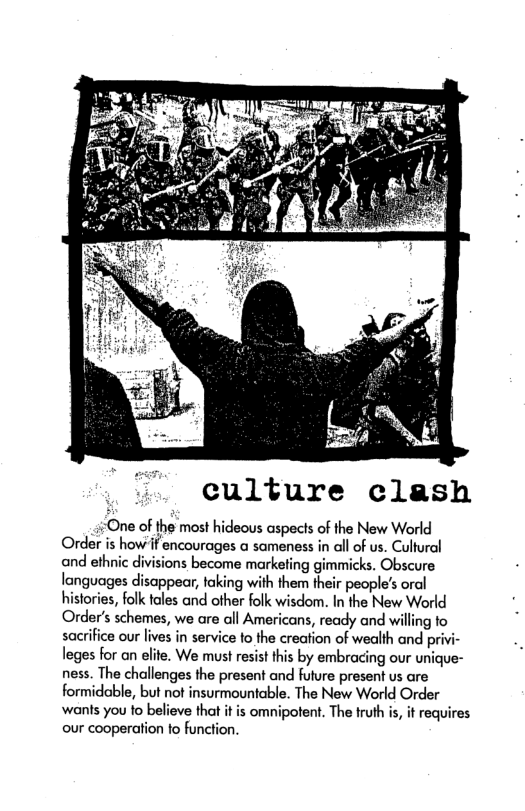
culture clash
One of the most hideous aspects of the New World
Order is how'if encourages @ sameness in all of us. Cultural
and ethnic divisions become marketing gimmicks. Obscure
languages disappear, faking with them their people’s oral
histories, folk tales and other folk wisdom. In the New World
Order's schemes, we are all Americans, ready and willing fo
sacrifice our lives in service to the creation of wealth and privi-
leges for an elite. We must resist this by embracing our unique-
ness. The challenges the present and fulure present us are
formidable, but not insurmountable. The New World Order
‘wants you to believe that it is omnipotent. The truth is, it requires
our cooperation fo function.
expleitatien o
v expleitatien
£ 5‘:" le need o wake up to the fact that no one has
their infefes} ind ~ not the government or polificians and
sureid¥hell RGEIBE corporations, financial inshifutions and other
dinistrative bodies of the New World Order. The most hid-
‘eous thing | see happening everyday is how the poor and
middle class suck up o the ruling powers and iry to emulate
them by becoming like the institutions that oppress them - cold-
hearted, ruthless, greedy, power-hungry, secrefive; inhuman.
That's not how life is supposed to be. We should be virtually
inseperable from the people we love, bond together and take
are of one another. That's how humans survived as a species
for thousands of generations. And, quite frankly, if we don't
start reconnecting as people; our species is done.
Corporations, banks and governments have the police
and military fo enforce their policies, but you know what? They
need us o cooperate or they have no power over us. No one
owes a second of their life fo any corporation, business or
government. Once you're bor, you have the right to uflize ll
the world's resources in order to live a happy, secure lfe - just
like birds, beetles and rats do. Why do animals live free, when
most people don't? I's because people have forgotten how fo
take care of themselves, and are convinced that they can't, so
they submit to economic domination and exploitation because
its all they are faught. It should be obvious that a social order
that rewards fraud and greed with hundreds of millions of
dollars while a third of the people on the pldi
isn't working. It's time to do something differes
that anyone who wants to try to work within the
order is an enemy of humanity, or is ot least.only interested in
improving his ::'Cer position within this sociely - at everyone
else's expense. Exploitation begets exploitation, plain and
With every paycheck, you sign away more of your life, a
life you'll never be able o buy backl Every payment of the rent
or morigage further fies you to the industrial state and weakens
your resolve to fight it, as you grow soft and comfortable,
sucking on the feat of your own repression. We'll never liberate
ourselves by going along with the social order that holds us in
economic slavery. Arisel Cut the ties, take the plunge into the
unknowable, take what you need and begin fo spend your fime
in delirious insurrection!
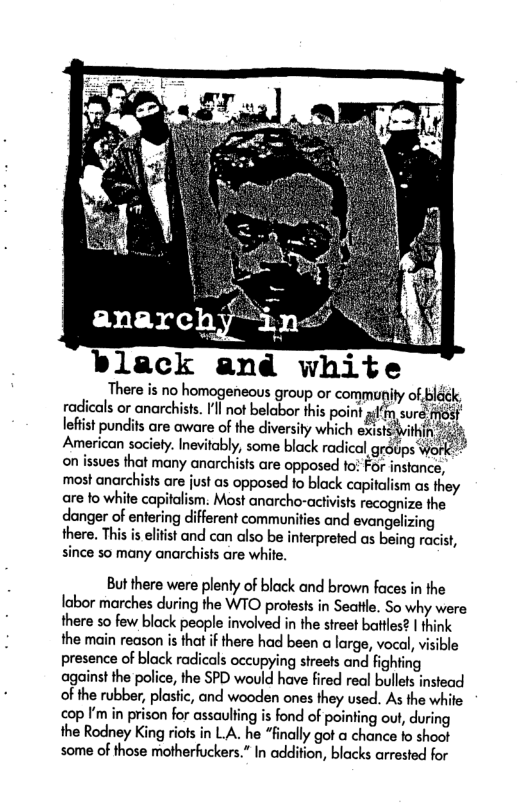
®lack and
There is no homogeneous group or community of bl
radicals or anarchists. 'l not belabor this point I'F
lefist pundits are aware of the diversity which existsvif
American society. Inevitably, some black radical grdps
on issues that many anarchists are opposed tos For instance,
‘most anarchists are just as opposed to black capitalism as they
are fo white cay m. Most anarcho-activists recognize the
danger of entering different communities and evangelizing
there. This is elitist and can also be inferpreted as. being racist,
since so many anarchists are white.
But there were plenty of black and brown faces in the
labor marches during the WTO proests in Seattle. So why were
there so few black people involved in the street battles? | think
the main reason is that if there had been o large, vocal, visible
presence of black radicals occupying streets and fighting
against the police, the SPD would have fired real bulles instead
of the rubber, plastic, and wooden ones they used. As the white
cop I'm in prison for assaulting is fond of pointing out, during
the Rodney King riots in LA. he “finally got a chance fo shoot
some of those motherfuckers.” In addition, blacks arrested for
the same crimes as whiles during the Seatle riots would likely
be facing serious jailfime, whereas most o the charges against
the white folks are being dismissed.
Yet even with the threat of this heightened level of repres-
sion hanging over them, accounts of the WTO protests indicate
that there were many black and non-whites involved in the
fighting from the firstdayiand ough the week. | find it
quite indicative of the acist, elifistattiludes which need to be
challenged and overcomejby lel ivoids that white middle-
class “pacifist” demopstrafors beatback black and Latino youth
who altempted to loot Niketown, and even grabbed one or two
of them to hold until police arrived fo arrest them. Luckily, the
liberal assholes got what they deserved and the kids escaped.
From an anarchist perspective, the “leffist” movement
suffers from tunnel vision. The main focus of the current white
leftist movement seems fo be inclusion, but the latest advance-
ment in anarchist crifique describes civilization as a global
death camp. Would equal opportunities in hiring and promo-
tion within a death camp make its continued existence accept-
able? To some peaple it would.
The sad thing about most American “leftist” groups is
that they do not even attempt fo address this argument. The
result of inclusion into the mainstream of industrial civilization
puts black radicals in the heinous position of being responsible
for the obliteration of the few remaining village community
societies left on the planet - mostly in sub-Saharan Africa. Not
only should thess socieies be preserved a all cos, they should
be recognized as being the ultimate achievement of human
existence.
Despite the differences inherent in reaching out to and
struggling alongside of people who have very different perspec-
tives concerning their priorifies in life, anarchists are coming
info contact with people outside their own. Many anarchists are
rejecting the privileges their middle-class backgrounds offer in
order fo pursue a much simpler way of life. This has put anar-
chists info places they've been missing from for too long -
seasonal farm-labor camps, urban drug-war zones, impover-
ished rural communities, and jails, right alongside their new-
found neighbors.
‘With resources and do-it-yourself skills o share with the
other downsized folks, anarchists are developing alliances with
prisoner support groups, police monitoring organizations,
people awakening fo the concephiof.environmental racism, and
are toking advantage of Bxce: roduction to feed hungry
people. Slowly the a rcome and strong fies
are being made fo it previously seen
anarchists as just “white'kids slumming.”
One thing the “leffist” and anarchists do have in com-
mon is their need o get away from campuses and put their
ideas inlo action. We could also do well by avoiding making
sweeping generalizations about people, whatever community
they identify with. For instance, | am an anarchist, but | am not
white. 'm Mexican - not Spanish, Mexican.
tewards a fugitive
future
Itis not possible fo create a new society, one based on
infegration with other people, our inner (higher) selves and the
world at large within the confext of our current society. A new
society must be built outside of this one. By working “within the
system,” one is only integrating oneself further into the system.
That's how the New World Order works. Anything that expands
o requires economic activity feeds the system. If's what is ex-
pecied of us. We are going fo have fo create new lives oulside
of the realm of economics and alienation (The thought that
human beings are apart from the natural world, rather than a
part of the Earth, is the original source of alienation. This is
what made civilization possible. Once people began o build
cites, they developed a feeling of superiority over their fellow
humans. So, first people became aliendted from their habitat,
then from one another]. That means devoing our life energy fo
making these changes, as opposed fo working for wages or
otherwise acquiring money. This may sound scary and weird,
but let me clue you in on something: Many native peoples have
Jestivals where everyone gathers together and gives away all
their possessions. At first, some people may have a lot more
than others, but by the end of the festival, everyone pretty much
has an equal share. Such outpourings of communal devofion
are such a threat fo civilized alienation that they are illegal in
Canada and the U.S. Ponder over that for a moment. It is
evident then that not only must a new social order arisg outside
of the current one but it must be done in secretfThe govetament
will not allow it.
Itis up o us, ourselves, our friends d we
love, to create a future we can truly believe in, ofje thatpro?
duces healers instead of serial killers, that cherishes teachers,
not athlefic rapists. That means sacrificing a lot of privileges. It
means facing fimes of peril, material deprivation, even hunger.
But what is the allenative? Nearly universal poverty, famine
and infernal wars of attrition like the war on “drugs” and “ter-
rorism.” Creating new lives for ourselves won't be easy, but the
rewards are unimaginable. Giving birth is always ths way.
innerview
iz
& E} with red “les rices” thaxten
' %y walidah imarisha
fig? What is anarchy?
Anarchy/anarchism is going through a prolonged re-
evolution and rebirth. The classical anarchist movement reached
its peak during the Spanish Revolutiorin1936. It was crushed
by Franco, Hifler and Mussolini and the apathy of the “demo-
cratic” nations. Since then, there have been entire new lines of
philosophical, aristic and academic inquiries that were either
inifiated, influenced by or influential fo anarchist crifiques.
Lingistics, anthropology and psychology have all led fo new
ways of viewing how our present civilization affects people,
sociefies and our environment. Anarchist scholars like John
Zerzan, Fredy Perlman and David Watson in the U.S., and John
Moore in the U.K. have presented advances and support for
anarchist arguments against authority and the concentration of
social power and wealth in all the fields of study listed above.
The picture they paint of the modem world is far from pleasing:
its actually quite horrific. And if's getting worse at an accelerat-
ing rate. The solufion-from the 215t century anarchist perspec-
fiveris fo uferly and complefay do away wih moden ehza-
fion before il does with not only us, but life as we know it
on planet Earih. This is the position | support-the insurrectionary
primitivist one, which views the m:gfl. ‘against civilization and
all it stands for as a life or death and immediate battl. It is our
love for lfe, and the real iving world that demands our loyalty
and respect. Nothing else matters.
What happened June 18, 1999 that resulted in
‘your imprisonment?
The eight most advanced industrial nafions meet every
year fo determine how they are going o direct the world's
economy-to the benefit of the wealthiest people in their coun-
tries. Over the past few years, there has been a growing aware-
ness among “first world” citizens to take responsibility for their
part in the domination and exploitation of the rest of the world.
So, on June 18, as the G-8 summit convened people in 40
countries and something like 140 cities rose p in opposition fo
the G-8 and their right fo rule the world. It was massive. Just
think of the WTO profest in Seaftle and imagine the same thing
happe in every maior city in Europe-riots, banks attacked,
entire cifies (not just neighborhoods) shut down due to fens of
thousands of people in the streets. The government of Pakistan
was rocked 5o hard that it fell a few months later. Cities in
Africa, South America, Southeast Asia, in every confinent,
experienced some sort of disturbance or otherwise presented a
demonstralion against the G-8 and their economic policies.
Eugene, Oregon experienced the biggest U.S. response fo the.
worldwide “Reclaim the Streels” fesfival, not necessarily in
numbers, but cerlainly in determination. There were several
attempts by the demonsrators to disperse, and each time they
did, the Eugene Police Department attacked, either by firing fear
gas or by arresting people who were separated from the crowd
or leaving, Each time the police aftacked, the demonstrators
counter-attacked. Twice the riot cops retreated. During one such
skirmish, | was aftacked by Sergeant Larry Blackwell. | threw o
rock up in order fo protect myself from an imminent beating and
it hit Blackwell, a glancing blow to his shoulder. I'd tried to foss.
it over his head o convince him to turn away from his assault
on me, but I'm not strong enough to heft a rock that size (about
5 pounds) that high, at that distance. So, | was arrested and
charged with Assault - assault with a deadly weapon.
What was the polices response fo your actions?
The cops chased me for a couple of blocks as | fried to
get away. Finally, | was struck across my head by ajpalice
baton and thrown face firstinto a parking lotivhi Wfi my
nose. On the ground, the police pepper-spayed me Whilg
i i i is*behind k. My
hands were pinned under me by the weight oo my
back. | couldn't understand them because of their gas masks. As
blood dripped onfo my shoulder and off my nose, Sgt. Blackwell
made several threats against me. The more clear-thinking cops
kept us separated though. | was convinced they were going o
take me fo some remote location and work me over before
taking me fo . | denied that | was hurt so that Id be out of the
custody of the EPD and info the “salfety” of the Lane Count jail
as quickly as possible.
Try fo picture that: me, with blood dripping down my
neck, my nose broken, my face purple across the right side and
both eyes blackened, felling the cops “No, no, Fm fine” while
aing to breathe after wcghla ooupli of blocks and then
ing pepper-s| l, while blowing blood out of my mouth
that's running m my nose. During the fric, e prosecu-
tor and police said | wasn'tinjured, WHILE describing my
physical condition. A
What kind of treatment did you mm from the courts?
They set an incrediblyhighvbail'on me; first off, which
really prevented me from finding good I&kyer, or preparing
for my fril. The judge was defermined o keep me from pre-
senting my political views to the jury and equally determined o
allow the prosecutor to tell the jury his thoughts about anarchists
and anarchy. She also allowed jury members fo be seated who
stated they could not be fair or impartial about anarchists under
my circumskance due fo our behavior on June 18. She also said
that the jury wasn't influenced by the media coverage of June
18. She finally set aside the sentencing guidelines in order fo
give me a longer sentence.
Do you feel like you received harsh treatment from the judge?
When Judge Bearden sentenced me, she acknowledged
that she had received several dozen letters attesting to my
history of non-violent activism, good reputation within the
anarchist community and the fact that the officer | assaulted was
not seriously hurt by my actions. These were all arguments that
Measure 11allows judges fo take into consideration when
determining a sentence. She could have set aside the Measure
11 minimum guidelines and given me a lesser sentence. Also, |
reminded her that the one bit of “evidence;” used to implicate
me for the Riot charge was a description of someone other than
me. So she gave me 70 months for the Assaultl charge and
departed from the sentencing guidelines for the Riot charge to
give me 18 months, and ran them consecutively, rather than
concurrently.
Yes, | feel like this is harsh treatment. Why did she do
this? Mainly, the city and county government needed fo have a
scapegoat fo use as an awd er dissidents that they are
i . Very convenient farget: I'm
6'Base of support for me. |
could also make the di 1 that being of Mexican ethniciy in
an overwhelmingly whitelSity coptributed to my isolation from
the activist community and vilification by the police and pros-
ecufor.
not from Eugene, so
What has it been like for you in prison?
t alow profile in here. Ifs weird that a person
who is 5o willing o refuse to recognize laws he doesn't agree
with (or any law, for that matter) has so little in common with
people who have a “criminal” mentality. Different values, |
suppose: wanting fo nurse and nurture the world as opposed to
‘wanting more things.
What is happening to anarchists in general in prison?
Most states are taking a pretty harsh stance against
‘anarchist prisoners, especially those who have remained active
since being sent down. They use regulations designed fo keep
close fabs on gang members and white supremacist groups fo
persecute anarchist prisoners, even those who don't get info
disciplinary problems in their institufions. So, anarchists are
kept isolated from general population prisoners as much as
possible and cut off from their “gang affiliations” on the outside:
activists and other anarchists. Personally, 'm not getting particu-
larly harsh treatment yet. The prisoncrats are frying to cut me off
from the outside by rejecting lots of mail because of “gang
symbols” the infamous circle “A”, and due to their anarchist
content, or as written on one mail violation nofice, their “vio-
lent” content. Many anarchist zines are rejected and that dis-
courages some publishers from trying to send me their zines.
Other anarchist prisoners | write to are locked down in segrega-
tion units with Aryan Brotherhood-types, who often try to kill
them. Harold Thompson (Tennessee), Chris Plummer (Texas),
Mark Barnsley (U.K.) and Rio Johnson (Oregon) spend a lof of
fime in the hospital due to recurrent attacks. Anarchists in lialian
jails are often found dead in their cells and anarchists in Greece.
are being jailed for long sentences for WTO-like activities.
Those Greeks, they've been out sireet fighiing for years and
‘wonder why ifs faken so long for us in the U.S. to get out and
get it on. We're forming an anarchist prison legal aid network
here in America fo see if we can't help each ofher out.
How are you getting on with your fife?
This is a weird fime to be in prison. Things could go one
of two ways: they could get a lot worse or better. Either way, Il
likely benefit from any changes. Ifthis government really cracks
down on anarchists out there, | might be relatively safe in here.
Also, | might ler my sentence light compared to
what future anarchist political prisoners in the United States get.
IFthings get beter: we win the rights of anarchists o be polifi-
cally active in prison and freely associate and write fo people
inside and outside our institufions; Measure 11 is overturned;
the prisoners’ network grows and thrives; the revolufion is
fought and won - | may get out sooner than expected and get
bock on with my life, my home in the woods and my delightul
daughter. What does it say about this society that the enlr way
fo get a political dissenter to keep his activism within the limits
of the law is fo put him in prison? I'm currently one of the most
highly “visible” anarchists in the U.S. This is strange for me, but
as it goes with so many aspects of my life, the worst thing tha's
ever happened fo me could turn out to bring vergipositi lts
in the future. @
Here are some ways to support Rob Los Ricos:
Talk with your friends and companer@s about Rob and
his case, Spread around his essays and articles, find maga-
zines that will pay Rob to write for them, collect money to help
support Rob and other political prisoners, write to Rob, get out
in the streets, smash the state.
Leiters can be sent fo:
Rob Thaxton # 1214
OSP 2605 Sige S
Salem, OR
818 SW 3rd Avenue
PMB 354
Portland OR 97204
Avoid using any images, logos.
aging or envelope. The prisoncrats will not pass anything on to
Rob that might even slightly offened their (in}sensibiliy.
for more (wlritings by Rob Los Ricos go to
www.ricanstruction.net/lockdown. html
anti/copyright
rob los ricos
Oistributed by Black Cat Distro
PO. Box 229, Roberts Creek, BC
VON 2W0 Canada blackcat@resist.ca
prison writings of anarchistjd
ROB LOS RICOS
Manufacturing Dissent ,
the final acts of! Uncdntrollable revolutionary ',
fury have not yet happened, Until the world, in part
or entirely, has,been freed from the yoke of capi- |
talism and all other Fnrms of privilege and author- /
ity more people will ‘revolt and with increasing ¢
urgency. - Rob Los;Ricos..ii:: N
Arrested by police during a 1999 Reclain The ¢
Streets demanstration, 'RebLas Ricos was accused
of throwing a rock at,’s tofUsed as a Latino
anarchist scapegoat, exampla’of what can happen
to those who dare tu l'EhE Rflh Los Ricos was
given a nearly 8 yaa Hprison:
an audio visual:terrorism tool
wwu.audiovisualterrorism.com